


Amorphous Materials and Optical Coatings Lab
(AMOC Lab)
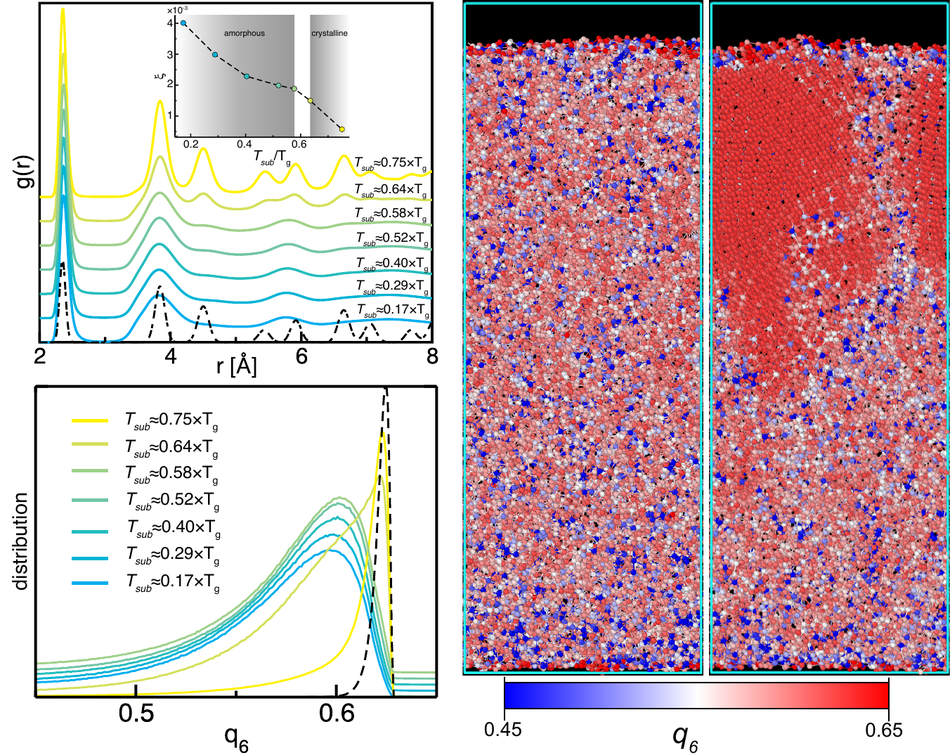
Research at the AMOC Lab
1. Optical Coatings for Gravitational-Wave Detectors: We investigate amorphous oxide coatings for high-precision optical mirrors used in gravitational-wave detectors. Our research focuses on the atomic-scale origins of mechanical loss, thermal noise, and optical absorption, with the goal of developing improved materials for LIGO and next-generation observatories such as Cosmic Explorer.
2. Atomistic Modeling and Machine Learning: We employ density functional theory (DFT), ab-initio molecular dynamics, classical molecular dynamics, and machine-learning interatomic potentials to investigate the structure and properties of disordered materials. Our computational research includes simulations of structural relaxation, atomic dynamics, electronic properties, and thermally activated processes.
3. X-ray Scattering and Atomic Structure Characterization: We use synchrotron X-ray total scattering and pair distribution function (PDF) analysis to investigate atomic arrangements in amorphous thin films. Our work combines scattering experiments with realistic atomic models to understand local and intermediate-range order and its relationship to material properties.
4. Functional Amorphous Materials: Beyond optical coatings, we investigate a broad range of disordered materials, including
amorphous semiconductors, solid electrolytes such as lithium phosphorus oxynitride
(LiPON), and other functional oxides. We seek to understand the relationships between
structure, electronic properties, and ion transport in these materials.
Research Support and Collaborations
Research at the AMOC Lab is supported by the National Science Foundation (NSF) and the Gordon and Betty Moore Foundation (GBMF), including collaborative research through the Center for Coatings Research (CCR). A recent NSF award (No. 2513491) supports the development of advanced optical coating materials for the proposed next-generation Cosmic Explorer gravitational-wave observatory.
Our group actively participates in the LIGO Scientific Collaboration and maintains research collaborations with leading universities, national laboratories, and research institutions in the United States and internationally. We also conduct experimental research at major synchrotron X-ray facilities, including Argonne National Laboratory and SLAC National Accelerator Laboratory, combining advanced experimental measurements with computational modeling to investigate the atomic structure and properties of disordered materials.
Research Opportunities
We welcome motivated undergraduate students interested in computational physics, materials science, scientific programming, and experimental research. Students in our group work on research projects involving atomistic simulations, machine learning, X-ray scattering, and the development of materials for gravitational-wave detectors.
Prospective students and researchers are encouraged to contact Dr. Prasai at kprasai@kennesaw.edu to discuss potential opportunities.


